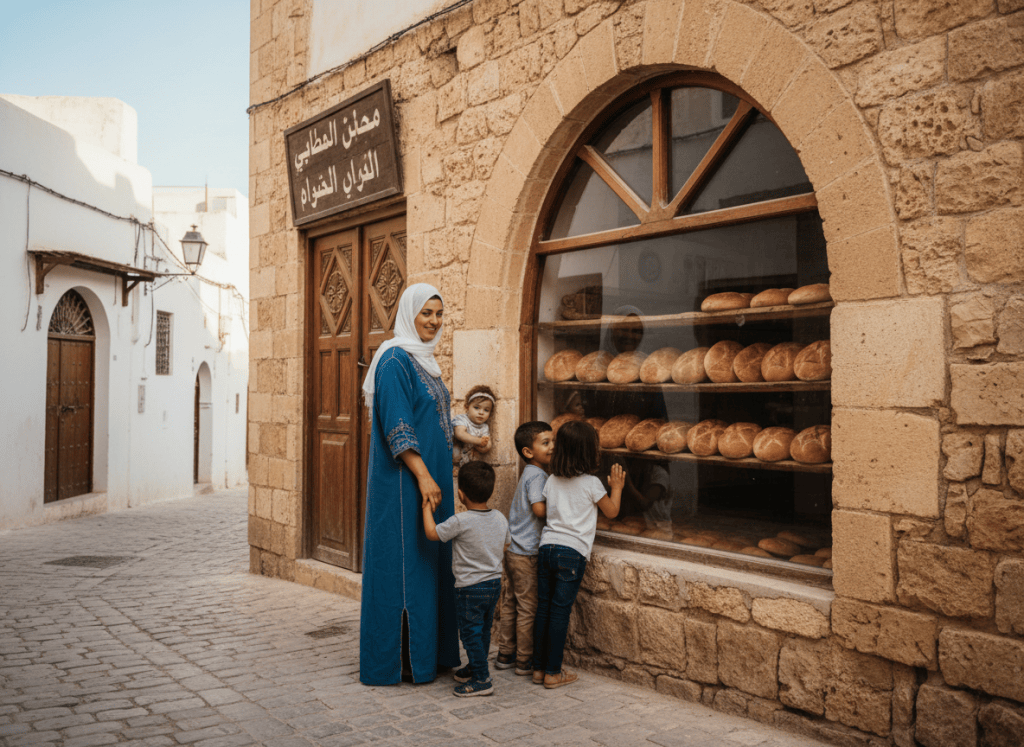
I was born in Kairouan, a city where the call to prayer floats through ancient air and history lives in the stones beneath your feet. People know Kairouan for its mosques—for their architectural beauty, their spiritual weight, their centuries of unwavering presence. For me, it was simply home—warm, familiar, safe.
My parents owned a bakery. It wasn’t large or fancy, but every morning it filled our street with the smell of freshly baked bread. We were six children, and I was the youngest. My older siblings used to tease me, saying I arrived when my parents were already tired. Maybe that was true. But I never felt unloved. We were not rich, but we were never afraid of hunger or danger. I learned early how to be content with little.
When I was six years old, I would take the public bus to school with my sister, who was in third grade. My mother trusted us. In our neighborhood, children belonged to the community. Strangers looked out for one another. I grew up believing the world was kind, predictable, and guided by faith.
School came easily to me. I loved learning. I loved the feeling of opening a book and stepping into something bigger. Education felt like a promise I was making to myself, even though I didn’t yet understand why it mattered so deeply. When I finished high school, I wanted more. I enrolled in university, eager, hopeful, proud.
I completed one semester.
That was when the proposal arrived.
He was a relative. Twelve years older. Living in the United States. To my family, this felt like safety, stability, and opportunity wrapped in divine timing. To me, it felt sudden. I was barely an adult, still discovering who I was, still holding onto dreams I couldn’t yet name.
When I spoke with him, something felt off. He didn’t believe in God. He dismissed money concerns as if responsibility were optional. There were moments that unsettled me, quiet red flags I tried not to see. I shared my fears with my mother. She listened patiently, then smiled.
“Time heals everything,” she said.
“Marriage will guide him.”
“God brings blessing.”
So I quieted my doubts. I believed patience could fix what love could not. I believed sacrifice was the purest form of devotion.
I withdrew from university. I prepared for marriage.
I arrived in the United States through marriage. Tunisia was changing then, finding its footing after uncertainty, but that life was behind me. I had crossed an ocean into a future I was determined to make work, despite my fear.
America felt loud and lonely. I had no family nearby, no community, no voice. My English was cautious. My world shrank to the walls of our home. I was a wife to a man I barely knew, expected to build love on faith alone.
Then, my first child was born.
The day I held my baby, something inside me shifted permanently. I looked at that tiny face and made a silent vow: I will protect you. No matter what.
But protection requires more than good intentions.
My husband did not take financial responsibility. Bills went unpaid. Questions went unanswered. I followed what I had learned growing up: a woman does not ask about her husband’s money. She trusts. She waits. She prays.
So I prayed.
I prayed for change, for guidance, for stability. I prayed for him to step into the role of provider, for our family to become what it was meant to be.
Nothing changed.
When we married, he did not give me gold—an asset meant to represent security and dignity. In our first year together, he didn’t buy me clothes or basic personal items. I learned to minimize myself. I told myself I needed nothing. I told myself gratitude was strength.
Then, I gave birth to my second child. Three years later, my third.
With each baby, my heart grew—but so did the pressure. Finances worsened. Tension crept into our home. I stayed silent, believing endurance was my duty. I folded my fears into prayers. I believed God was watching.
Then the world shut down.
The pandemic took whatever stability remained. My husband grew angrier, louder, meaner. He left often, saying he was meeting friends. I asked nothing. I questioned nothing—until the truth found me, painfully and suddenly.
He was gambling.
Not casually. Not occasionally. Gambling ruled him. Paychecks were garnished. Debt closed in around us. Every empty promise tightened a knot inside my chest.
One night, he couldn’t sleep. I asked why. His voice broke as he confessed everything. He told me he could no longer pay the mortgage.
In that instant, fear swallowed me—but not for myself. For my children.
That was the moment I understood something fundamental: patience alone would not save us. Faith without action would not protect my kids.
The next day, I searched for work.
I was afraid. I had never worked in America. I had three young children. But fear sharpens resolve. I found a job at the YMCA. My hands trembled on my first day. My body ached. My English faltered. But I showed up.
Every day.
While I worked, my husband lost his job. He claimed he started a business. Instead, he borrowed money from his cousin and continued gambling. When the money vanished, so did his control. His words turned cruel.
Soon after, his hands did too.
I won’t describe those moments. I don’t need to. The fear, the humiliation, the heartbreak—they are etched deep enough already. I stayed longer than I should have because I believed suffering made me stronger. I believed leaving meant failure.
I was wrong.
Something inside me finally broke—and something stronger took its place. I saw clearly that my faith did not demand silence. That God did not ask women to shrink for the sake of peace. That my children deserved safety more than appearances.
I chose divorce.
It was the hardest decision of my life.
By then, I was working two jobs. I was managing a household alone. I was exhausted beyond words. But I was standing.
I fought for my children—and won custody.
I fought for child support—and won.
I am still fighting for my home.
Some days, the fight feels endless. There are moments when exhaustion sits beside me after the children fall asleep, whispering doubts into the quiet. But when I look at their faces, I remember exactly why I endure.
I did not come this far to give up.
I came from a small bakery in Kairouan, where bread rose slowly with patience and care. I am made of that same dough—pressed, heated, tested, but never destroyed.
I am a mother.
I am a survivor.
And for my children, I will never stop standing.
 Travel Life Stories Inspired by True Events
Leave a comment